

Some things seem so self-evident, it seems silly to say them. Don’t text and drive. Just because it worked once doesn’t mean it’s safe. DIY dentistry is a very bad idea. And if you need evidence for the last one, look no further than a recent case published in the BDJ.
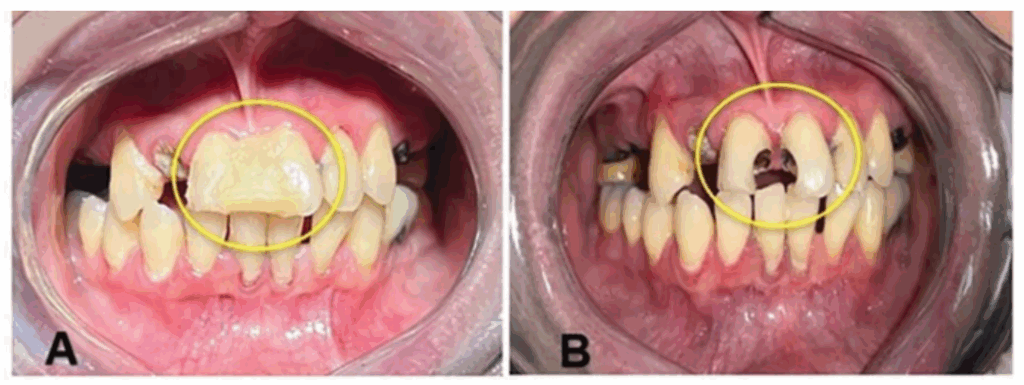
The patient was a 41-year old woman who came in complaining that her upper front teeth hurt – teeth that were found to have bulky, rough, tooth-colored material packed between them, extending into her gums. Both teeth were tender to the touch.
Asked about the material, the woman explained that she’d been using a DIY dental filling kit she’d bought online – one with beads that you soften in hot water, mold, and press into place. When the material would loosen or fall out, she’d just put on more.
But this wasn’t the only problem. She had seven root stumps, which are what’s left when teeth break down to the gumline, and three teeth showed obvious decay. The patient admitted to using the same DIY filling material on those teeth, too. She said she was planning to replace the root stumps with false teeth she’d found online.
Meantime, deep decay had also developed under the patient’s homemade fillings. The cavities had eaten all the way through to the pulp – the living tissue inside each tooth. Root canals were recommended for both – not the greatest option from a biological point of view, but that’s another story for a future post. (In the meantime, if you’re curious, this post from a colleague’s office offers a good starting point.)
When asked why she tried to be her own dentist, she gave three reasons: cost, convenience, and dental anxiety rooted in childhood experiences.
The cost concern is certainly understandable, but it’s also ultimately backwards. Yes, dental care costs money. But while treating a small cavity might run a couple hundred dollars, letting it progress to the point where a crown is needed – or even extraction and replacement – can easily cost thousands.
By trying to save money by filling her own teeth, this patient wound up with treatment needs far more expensive than if she’d addressed problems early. Prevention really is the most affordable path.
Convenience? It makes sense on the surface. Who enjoys trying to fit appointments into a schedule already packed with work, school, child care, or other responsibilities? But “convenient” stops being so convenient when you wind up dealing with persistent pain, infections, or dental emergencies that force you into care anyway? Real convenience is having a dental team that works with your schedule and plans treatment in phases that fit your life, not just what’s dentally ideal.
Then there’s the anxiety. Childhood dental experiences can leave lasting impressions, it’s true. In fact, bad dental experiences in childhood are one of the most common reasons for dental fear. That fear is real. And it’s valid. The trouble is that avoiding care because of that fear creates exactly the dental scenario you dread most: more invasive procedures, more time in the chair, more discomfort.
When designing our practice, Dr. Railand actually made a concerted effort to create a space that would make trauma unlikely. The atmosphere is calm and welcoming. We take time to listen, explain what’s happening, and involve you in decisions about your care. You’re not rushed. You’re not talked down to. You’re not just a mouth that needs fixing.
If you need extra help to be comfortable, we also offer a complete range of options. For gentle, drug-free relaxation without sedation, we have NuCalm. If you need something a little stronger, nitrous oxide is available, as well as oral sedation. IV sedation is available for those who need deeper relaxation during procedures. The point is meeting you where you are, not forcing you to white-knuckle your way through treatment.
Because the ultimate goal is to make sure you leave here feeling better – not just physically but mentally and emotionally, too. We want you to feel great about the experience itself. That’s something that supports good healing, too.
Unfortunately, that woman in the case study isn’t an outlier. If the internet has taught us anything, it’s that people don’t always make the best decisions. They try to scale their own teeth with sharp instruments they buy off of Amazon or even eBay, damaging their gums and inadvertently pushing bacteria deeper into the tissue. They try to repair broken dentures with superglue or hardware store adhesives, creating ill-fitting appliances that shift with every bite, irritating tissue. They cement loose crowns back in place with whatever’s handy, trapping bacteria underneath and setting the stage for infection.
Even something that seems so benign – trying to “heal cavities” by remineralizing your own teeth instead of having them properly treated – can have terrible consequences. Too often, the decay has already gone deep into the dentin and continued to spread, ultimately killing the tooth’s nerve and leading to abscess. We’ve seen it ourselves from well-meaning patients who truly believed they were doing the right thing.
Instead, as with the online dental kits that are marketed as affordable, simple solutions, all this does is delay real treatment while unseen problems get worse. It can create a false sense of security while decay progresses, infections develop, and simple fixes become complex cases.
You deserve actual care – the kind that addresses root causes, preserves your long-term health, and treats you like a whole person rather than a set of symptoms.