

If you read our last post about the hope of “healing cavities naturally,” you may have picked up on an important truth: Your teeth are constantly losing minerals and constantly gaining them back.
Demineralization happens when you consume anything sugary or acidic. Conditions in the mouth turn acidic, which temporarily softens tooth enamel. Once the oral environment is back to neutral, minerals in the saliva can get on with remineralization.
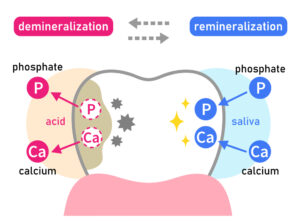
This is a natural and nonstop cycle. So despite how some describe it, remineralization isn’t something you “do” like brushing or flossing. Your body does it for you. The question is whether you’re giving your body what it needs to do this effectively and efficiently.
Feed the System: Minerals & Balance
Almost a century ago, dental researcher Dr. Weston A. Price observed that traditional cultures who ate nutrient-dense ancestral diets experienced far fewer dental problems than those that had shifted to modern diets with their highly refined ingredients. Around the same time, Dr. Melvin Page showed the importance of mineral balance in the body and its reflection in saliva.
Though the research tools we use today are more sophisticated than those Price and Page had access to, the fundamental idea they highlighted still holds true: Remineralization depends on mineral availability – and on the body’s ability to regulate those minerals.
As mentioned, saliva is the delivery system, carrying calcium and phosphate to enamel. If those minerals aren’t circulating in adequate amounts – or if the body lacks the nutrients needed to manage them – the process becomes less efficient.
 While most people associate calcium with dairy products, that’s hardly the only source. Many plant foods contain good amounts of the mineral, too – especially leafy greens, sesame, almonds, and calcium-set tofu. Phosphorus is widely available in legumes, seeds, nuts, whole grains, dairy, meat, and fish. Magnesium is another key player in mineral metabolism and abundant in beans, greens, pumpkin seeds, and whole foods of all kinds.
But minerals don’t act alone.
Vitamin D3 (cholecalciferol) improves the body’s ability to absorb calcium and maintain appropriate levels in the blood. Vitamin K2 works with D3 by activating proteins that guide calcium into bones and teeth and away from soft tissues. In simple terms, D3 helps you absorb calcium; while K2 helps you use it wisely.
Depending on where you live, your sun exposure, and lifestyle, getting enough D3 may require supplementation, as your best source is simply from sunlight exposure. If you do supplement, it’s a good idea to choose one that’s combined with K2 for insurance, although it can be found in fermented foods, and many animal products.
Getting enough protein also matters. Whether that protein comes from lentils and tempeh, eggs and yogurt, fish or tofu, consuming enough is important for saliva quality, as saliva also contains proteins that help stabilize minerals and protect enamel.
Give Your Teeth Time to Recover
Every time you eat – especially fermentable carbohydrates – you also feed the bacteria in your mouth, some of which go on to produce acids. This temporarily lowers oral pH and pulls minerals out of enamel.
As noted, this happens no matter what. The key is how often.
The normal pH of a healthy mouth is roughly neutral. In this environment, remineralization needs some time to happen. But it’s robbed of a lot of that time when a person grazes through the day, sips sugary or acidic drinks over hours, or simply snacks a lot. When conditions remain acidic, rebuilding has to wait.
 In fact, eating and drinking less often can sometimes have a bigger impact than banishing entire classes of fermentable carbs – all potato chips, say, or candy, or pasta. Instead, think structured meals. Think cutting out snacks. Water instead of sweetened drinks. These simple shifts can dramatically improve the balance between mineral loss and mineral repair.
And a special mention here about acidic drinks – soda, coffee, energy drinks, fruit-based drinks, and so on. These lower oral pH directly, no matter their sugar content. Enjoying one occasionally is perfectly fine if you like them. Sipping them throughout the day, every day? You can see why that might be a problem.
Support the Surface: Smarter Hygiene Choices
The third key to supporting the remineralization process is your daily oral hygiene.
Brushing and flossing reduce biofilm (plaque) buildup. Disrupt those bacterial communities, and you disrupt acid production, too. But you can also go a step further by using a toothpaste that contains hydroxyapatite (HAP).
 HAP is a mineral form of calcium phosphate, which happens to be the stuff that tooth enamel is mostly made of. When used in toothpaste, it can help supply additional calcium and phosphate directly to the tooth surface, supporting repair of early microscopic defects. Studies have shown that its preventive power is at least on par with fluoride but with “superior biocompatibility and lack of toxicity,” as the authors of a 2025 systematic review put it.
One more thing: Don’t brush your teeth immediately after eating, especially when eating fermentable carbs. Instead, rinse your mouth with water and wait at least a half hour before brushing. This gives your saliva a chance to buffer the acids first. Otherwise, you just wind up brushing them into your teeth, encouraging erosion.
The Bigger Picture: Your Mouth Is Not Separate
Remineralization doesn’t happen in isolation. It reflects what’s happening in the rest of the body.
Consistent, good quality sleep, for instance, supports hormonal regulation and immune balance, both of which influence saliva composition. Chronic mouth breathing can dry oral tissues and lower pH, making remineralization more difficult. Dehydration also reduces saliva flow, while persistent stress can affect immune signaling and microbial balance in the mouth.
None of these factors act alone. But together, they shape the environment in which your teeth are trying to repair themselves.
When the whole system is supported, enamel has a better chance of keeping up with daily wear.