



Viewed from the outside, a tooth looks pretty simple: smooth, hard, solid. But zoom in — and keep zooming — and there’s an astonishing complexity:
Despite many years of trying to recreate or regenerate natural tooth structure, the goal remains elusive. Some research teams have come close, and their work routinely generates headlines. That’s because the enamel you get is all the enamel you’re going to get. Once your adult teeth have developed, the specialized cells that made their enamel are gone. You can replenish minerals that enamel loses, helping it to stay strong and intact, but you can’t grow more to replace what’s lost.
While enamel isn’t living tissue, it is the hardest substance in the human body thanks to the precise way its tiny hydroxyapatite (HAP) crystals are shaped and densely organized. It’s perfect for protecting the living tissues beneath, starting with the dentin. This softer layer is shot through with microscopic channels called dentinal tubules. They extend inward toward the pulp at the center of the tooth and contain fluid, cellular extensions, proteins, and other organic material. The pulp itself is rich with blood vessels and nerves, with the ends of some nerves even extending a short distance into a tubule here and a tubule there.
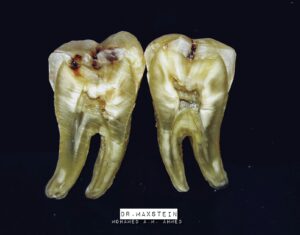 If the dentin is ever exposed, though, trouble can follow. Even the smallest thing stimulating an area of lost enamel or exposed root can set a nerve firing: a sip of cold water, a taste of something sweet, a puff of air against the tooth. The stimulation can cause the dentinal fluid to move, which can agitate the deeper nerve fibers within the tooth. You get that sudden, sharp jolt of tooth sensitivity.
The most obvious solution for addressing sensitivity is to simply block the open tubules and so reduce the movement of fluid. That brings us back once again to those tiny crystals of hydroxyapatite. Not only is it the main component of tooth enamel, as well as bone, it also makes up much of the dentin. When it’s made into particles small enough to work their way into those microscopic openings, it can effectively seal off the tubules.
That’s the idea behind using nano-hydroxyapatite, or nHAP, in toothpastes and other products for sensitive teeth. At this tiny scale, they seem to do a better job of closing off the dentinal tubules. This has been demonstrated in studies like this one from 2019, which compared 80-nanometer and 300-nanometer HAP particles, and found that smaller was indeed more effective.
Other studies have focused more specifically on using nHAP to reduce sensitivity. Just recently, a systematic review and meta-analysis brought together13 randomized controlled trials involving 609 people with dentin hypersensitivity. To be included, a trial had to directly compare nHAP with a more familiar ingredient used to reduce sensitivity: fluoride.
Overall, it appeared that at two weeks, nHAP toothpastes did a better job of reducing sensitivity, measured by both pain ratings and response to touch. By eight weeks, though, fluoride seemed to perform better when sensitivity was tested with a blast of cold air. (Of course, there are other aspects of fluoride worth considering, too.)
Concentration seemed to matter, as well. In a subgroup analysis, 15 to 20% nHAP toothpastes produced the strongest reductions in sensitivity — although in everyday life, what counts as the “best” concentration may depend on what you’re wanting the hydroxyapatite to do. Earlier research on enamel remineralization has sometimes been used to support 10% as the “optimal” concentration. For sensitivity, however, a higher concentration may be needed.
Even so, the word “nano” can give some people pause. After all, if these particles are small enough to enter the microscopic spaces in a tooth, could they also wind up in places where we don’t want them?
It’s a reasonable question, especially since some early safety research couldn’t rule out all potential concerns, particularly with respect to certain particle shapes. But evidence has continued to develop, and in 2025, the European Commission’s Scientific Committee on Consumer Safety concluded that the specific forms of nHAP it evaluated were “safe when used at concentrations up to 29.5% in toothpaste, and up to 10% in mouthwash.”
At least this is the case for very specific rod-shaped particles, not all forms of nHAP across the board. The committee found that there was no significant absorption of nHAP by the soft tissues of the mouth and that any swallowed particles would be expected to dissolve rapidly in stomach acid.
Altogether, the science thus far gives us good reason to consider hydroxyapatite another useful tool for supporting healthy teeth. We already know it can help remineralize enamel and prevent tooth decay, with clinical research finding fluoride-free HAP toothpastes comparable to fluoride toothpastes for preventing decay.
Now we have growing evidence for another use: sealing those tiny open tubules that can make sensitive teeth hurt. That makes nano-hydroxyapatite an especially useful option to have — one that works with the same mineral our teeth are built from.
Image by Mohamed A.M. Ahmed, Creative Commons 4.0 International